Taxonomy
Domain: Eukaryota
Kingdom: Animalia
Phylum: Chordata
Class: Reptilia
Order: Squamata
Family: Colubridae
Genre: Natrix
Species: Natrix maura
Conservation Status of the Species in Portugal and Worldwide
Portugal

World
Features and
Habits
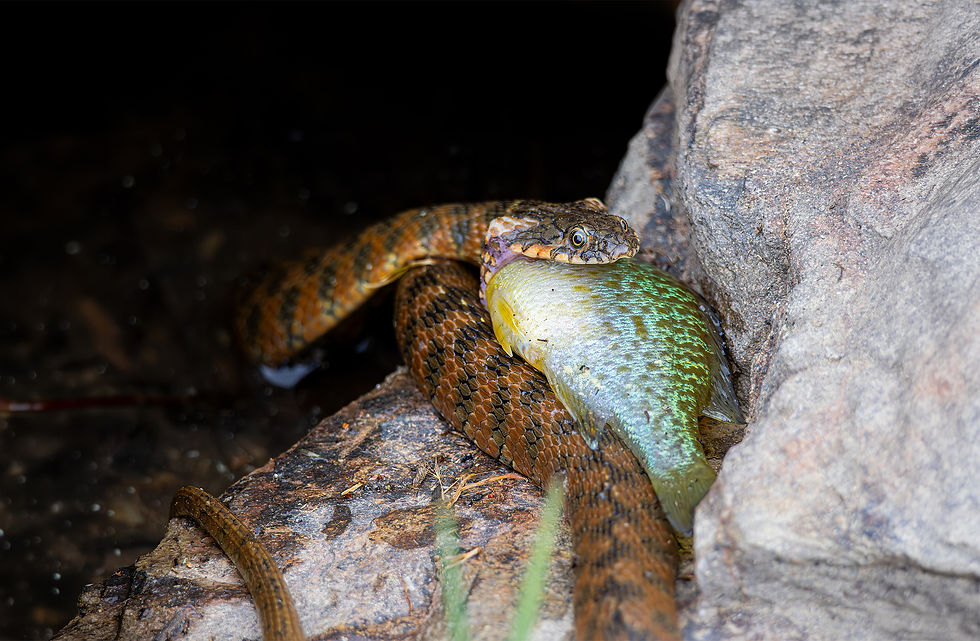
In terms of size, it measures between 65 cm and 130 cm in length, making it a medium-sized snake. Regarding its distinctive characteristics, unlike many snakes in Portugal, this one has round pupils. Furthermore, its head is distinct from its body, having a wide, flattened snout, like a viper, hence its name, although it is not venomous like vipers. The body is primarily cylindrical, not flattened, and covered in scales that vary in color from brown on the upper side to yellow and green on the underside. It has darker zigzag stripes along its body. Although the name suggests a connection between this species and a viper, it does not have venom-injecting fangs.
This species is primarily active from spring to late summer. It hibernates (brumation) around winter, depending on air and water temperature. Hibernation takes place out of water in dry, protected locations. It feeds on amphibians, small fish, and invertebrates, especially aquatic species, as this snake's main ability is swimming. It hunts both by actively pursuing prey swimming through watercourses (generally in warmer waters where its metabolism is more active) and by ambushing them, for example, by remaining near roots on the water's surface or underwater, camouflaging itself among them, waiting for an opportunity (generally in colder waters where its metabolism is lower). It nests around June and July, near tree roots or organic matter, where it lays around 4 to 30 eggs. They take about 2 to 3 months to hatch. It has a lifespan of about 20 years. Although it is a snake, it is not considered a risk to humans, and attacks are very rare.
Habitat and Distribution
It is a common aquatic reptile and is generally sighted throughout the country. The types of habitats it frequents include various bodies of water with little movement, such as streams, lagoons, and others. They prefer sunny watercourses to warm themselves, as well as aquatic plants, tree roots, or logs where they can hide and rest.


