Taxonomy
Domain: Eukaryota
Kingdom: Animalia
Phylum: Chordata
Class: Mammalia
Order: Rodentia
Family: Sciuridae
Genus: Sciurus
Species: Sciurus vulgaris
Conservation Status of the Species in Portugal and in the World
Portugal

World
Features and
Habits
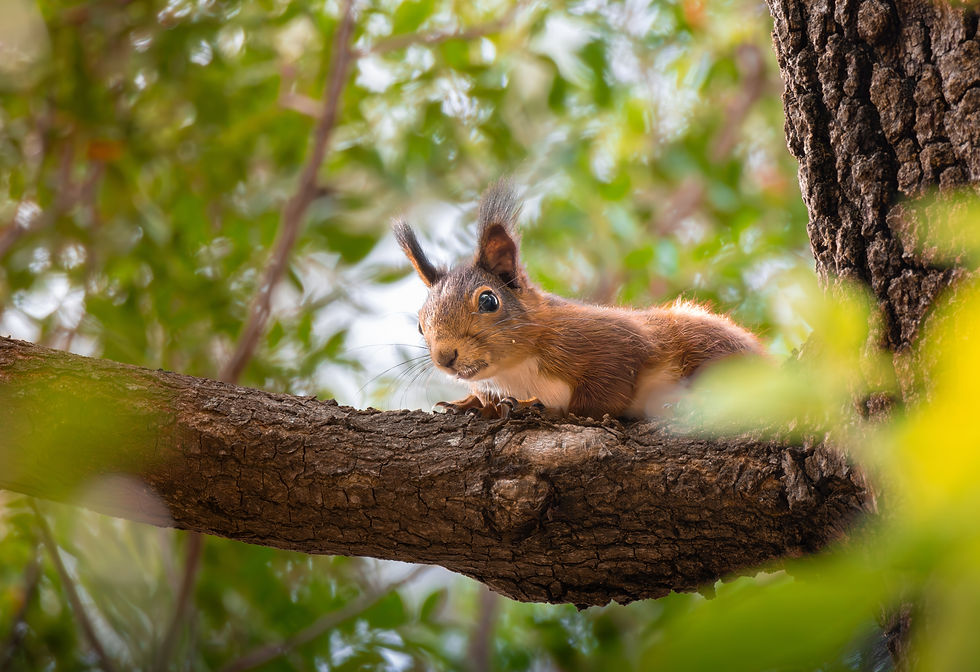
In terms of size, it measures between 33 and 45 cm in length, including the tail. Regarding its characteristics, its fur varies in color from reddish-orange to dark brown, and in winter it may become more grayish. The tail is long and thick, and is used both for balance when jumping from branch to branch and for communication. The ears are furry at the tips, something more noticeable in autumn and winter.
It is diurnal, preferring to be active in the early and late hours of the day. It lives in tall trees and is often seen jumping from branch to branch. It makes burrows in these trees where it stores its food and where it stays protected when not active. It is most active in the autumn, when it stores food for the winter. It is herbivorous, feeding on seeds, nuts, fruits, fungi, and tree bark. In winter it does not hibernate, but spends most of its time in its tree burrow. It reproduces in the spring and the gestation period lasts 38 days; each litter consists of 3 to 4 pups. The pups are born blind and hairless, and weaning occurs over 3-4 weeks. They become independent after 4 months. They are solitary and territorial.
In terms of interaction with humans, they are quite cautious and tend to flee as soon as they hear someone nearby. They run to the trees for safety. Although very shy, they sometimes show curiosity, especially in quieter areas. Some become accustomed to receiving food.
Habitat and Distribution
The habitats it prefers are dense forests, favoring conifers (pine, fir), but it is also present in deciduous forests (oak, hazel...). It prefers trees that produce nuts and are tall, allowing it to escape danger and build shelters. It is important for its habitat because it spreads seeds and sometimes hides and buries fruits, which often leads to the formation of new trees. This is a sign of a calm and healthy forest.
It is a resident mammal. However, it is much more present in the north and center of the country. It is rare south of the Tagus River. The places in the country where there are more sightings are in the North, in the Peneda-Gerês National Park, in the Montesinho Natural Park, and in the Gaia Biological Park (in the wild). In the center, in the Arouca Geo Park, in the Buçaquinho Environmental Park, in Esmoriz, in the Fontelo Forest in Viseu, and in the Choupal National Forest in Coimbra. In Ribatejo in the Sete Montes National Forest in Tomar. And in Lisbon, in the Monsanto Forest Park, and in the Sintra-Cascais Natural Park.


